
Category: Features

  • When Things Fall Apart: Reflecting on 2020

    So many things were ready to go from trips, to conferences, a new website featuring in-person Focusing training (remember being with people?) and then things fell apart. I just remember saving all my energy for clients and students and then wine-ing at the end of the night with my wife. I’m sure I am not alone.

    When things begin to fall apart there is that natural tendency to hold on tight and keep it together. Yet, at some point I was able to step back and see that a natural process of change had begun before COVID hit, and was accelerated by it. At first I was disoriented and wanted my “normal” life back. Over time it felt a lot better to just let go and trust that from the edge of uncertainty would emerge fresh steps of growth. How did that happen?

    I leaned into my daily and weekly practices of Focusing (and Focusing partnerships), meditation, stretching-yoga-walking, and Trauma Releasing exercises (TRE). Connecting with my wife at the end of the day who began teaching second-graders online helped too.

    What I have learned is when things fall apart it is helpful to step back and rest into the present moment and larger space of conscience awareness and view circumstances as a natural process of change. Then it becomes less something to fight and more of an uncomfortable and vague sense of something missing or not right … yet.

    My practices help me to be with that unknown and uncomfortable edge of my experience. Showing up for myself, listening to my suffering and being with the unknown and unclear has led to surprising changes.

    After 20 years of practicing psychotherapy in West Seattle, I closed my practice. I now practice full time on Vashon out of my beautiful home based studio. I invested in an outdoor seating area and let the breeze blow through my office for the occasional in-person visitor. Telehealth has transformed my practice and ability to work from home. As a body centered therapist the virtual format is not ideal. Screen time tires me and my body senses the absence of a real presence. At the same time I am so grateful for the opportunity to continue working with lovely souls – without the commute.
    — Coming in January 2021 —

    This will be my last Morrison Therapy Newsletter! In the new year you receive a newsletter from my new business the Seattle Focusing Institute. It is a dream come true developed with many little steps and missteps over the last couple of years. It will be a hub for my teaching and a growing Focusing community in the area. I look forward to developing my capacity as a teacher and mentor for those wanting to bring Focusing into their practices and lives.

    Lastly, I want to express a deep gratitude to all who I work with and who have supported me with their kind words of thanks during a really difficult year.

    May we all share in the shelter of each other and flourish through mutual kindness in the new year. ♥



  • Bridging Cultures through Language

    Bridging Cultures through Language

    A Brief Reflection on the Focusing Weeklong in Chile
    by Kara Hill, MA, LMHC, FOT

    The most striking part of my experience in Chile was being part of a community in which we were deeply connected by our different languages rather than having these differences create a barrier. One day sitting at the lunch table, four of us were conversing in English. One woman looked up and realized the man sitting beside us spoke only Spanish. Without asking him whether he wanted to be included, the woman immediately began to translate our conversation and the rest of us slowed to accommodate the process. It was an offering of inclusion that assumed, “You are with us!” He was already a part of our “we” without having to ask and without our languages creating a barrier.

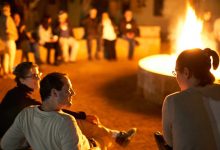
    One night I sat around a campfire with three people. I, the English Speaker with little Spanish, a native Chilean with little English, and two people from Uruguay who were bilingual. The four of us enjoyed a long, warm and connected conversation, finding things in common, learning and growing together. This happened because the friends from Uruguay took turns translating everything between us all. The most striking part, again being, there was no discussion about translating and whether or not it was needed. It seemed that the shared assumption and instinct at the conference was always to include. I know that translation is a rigorous task and was touched by the generosity of others to fill the gaps between us like this. This unifying, created a freedom to play together, laugh, and learn from one another in a holistic way, and a depth of community was felt beyond any I had before experienced.

    The different languages at the conference also made me very aware of my own lack of a second language and the privilege I have to go to other countries and rely on the people in those places to have some proficiency in my language. In Chile, I met a six-year-old girl who shyly spoke English to me having learned it in her Kindergarten class. Her older brother spoke with much proficiency. I wondered about why I had never been taught and how this gap in American education separates my country from the rest of the world. Thus, while I speak very little Spanish, I found myself offering as many words as possible. I was accepted and un-judged, unlike the way I have seen immigrants to the United States criticized and ostracized for accents or imperfect grammar. In Chile, sometimes I knew I had said things quite awkwardly, yet even a single word uttered clumsily in a foreign accent was received with appreciation. I felt so accepted in this, it fueled my natural drive to keep trying and words I didn’t even realize I knew were drawn out from somewhere within. Spanish is a language I’ve always found difficult and often wondered if I was incapable of learning. In Chile, it was available to me as I had never experienced before. Being part of this community, it seems, brought something together inside me as well.

    Kara Hill was Certified as a Focusing-Oriented Therapist by Jeffrey Morrison and is a graduate of his training program.
    photo credit:  José Ignacio Salazar for The International Focusing Institute
  • Personal Reflections of this Year and Looking Ahead

    Personal Reflections of this Year and Looking Ahead

    I had reconstructive surgery on my right ankle at the beginning of April. My mindset was one of ending and beginning. I think Spring is the perfect time for such a journey. In my recovery, I spent two weeks resting on my couch at home watching spring unfold outside my windows. Sometimes we need an event in our lives to facilitate change. Surgery, for me, was an event marked with endings, shedding commitments, and beginnings, making room to break new ground. Ahead is a year of recovery – physical healing infused with spiritual renewal. I am shifting my work more to Vashon, away from commuting, reducing the number of clients I see in order to dedicate more time to my teaching and training. I am reminded of Kierkegaard’s works, as I sense into “fear and trembling,” in tandem with growing opportunities: I notice that it all feels just right!

    My three-plus years of planning and facilitating The Advanced and Certification Weeklong through The International Focusing Institute, came to completion on the coast of Chile in January. It was a remarkable experience of people from around the world coming together with mutual respect and common passion, a cantata of English and Spanish smoothly playing back and forth. The depth of connection people can make in such a short time, when our needs are met and we listen openly to each other, continues to amaze me.

    The 29thInternational Focusing Conference in Mérida, Mexico in March was incredible in its own unique yet similar ways. I presented on “Ten Key Aspects of Working with Trauma.” (Click here to email me and request a copy.) Thirty people from around the globe attended my presentation, which was simultaneously translated into Spanish. During this presentation, I had the opportunity to reconnect with a woman who I’d had the chance to work with for one session at the Weeklong conference in 2017, where we processed a trauma she had experienced as a child. I invited her to come to the front of the room, where she courageously spoke about the session we’d had and how her life had changed since then. It was a gift for both me and the group to hear her story and witness the kind of change a Focusing-Oriented approach can facilitate in working with unwinding stuck patterns and frozen remnants of trauma. Such a vivid first-person account of healing was an inspiration to all present.

    With the International Focusing Conference and three-year Weeklong Planning Committee completed, I have a reprieve from commitments to travel and present for the near future and look forward to dedicating my time to training, teaching, and mentoring. I am blessed to have a wonderful group of first-year students and am looking forward to beginning my second-year program again this fall. Additionally, I have begun work on a new website that is designed to support Focusing training and building a community of Focusing-Oriented therapists, healing professionals, and spiritual seekers. I look forward to walking with you all on the journey (and on two feet again!)

  • Why I’m Going to the Felt Sense Conference

    Why I’m Going to the Felt Sense Conference

    by Kara Hill, MA, LMHC, FOT

    The Felt Sense Conference was established a year ago as a commemoration of Gene Gendlin’s life and a furthering of his work. It is a celebration especially of his philosophy. While I appreciate the mindful and somatic aspects of Focusing, what makes it truly unique in the work of psychotherapy is the rich philosophy underpinning it. Focusing-Oriented therapy is not a simple technique to apply, but a whole way of understanding being human and in relationship.

    In his philosophical work, Gendlin rejects the common notions of categorical thinking and fixed patterns. He demonstrates that we are primordially whole beings in interaction with everything (one another and the world), and that we are not objects but processes. Being human is never static. It is an ever growing, changing, emerging experience. Everything I experience is both a part of my unique process and actively in interaction with every -thing and -one else. This inherently intersubjective thinking reaches beyond “parts work” and self-regulation to emphasize a non-verbal whole “feel” of things within which even the tightest knots have the space to unfurl, naturally and in their own right way. This non-verbal, sensed whole, or “felt sense” of things is what makes Focusing truly effective for me and my clients. While we can all experience a felt sense without fully understanding it, the felt sense is best explained within the context of the philosophy underpinning it.

    In addition to my passion for his philosophy, I had the opportunity to speak with Gene on three occasions. Once he told me I was right-on, once he informed me I was dead wrong, and once we merely confused each other. I have deep gratitude to Ann Weiser Cornell for the gift of having had these encounters and am struck by how even such small contacts forged a real sense of connection to the man.

    Photo courtesy José Ignacio Salazar for The International Focusing Institute

    Connection to Gendlin and his philosophy were not the only draws, in my deciding to attend the Felt Sense Conference this year. It bears saying that I will also have the opportunity to further a friendship that was established in Chile at the Weeklong this past January. The Weeklong produced a friendship so deep and dear to me that I am, in some ways against logic, traveling to New York City to both support her teaching and to simply spend time with her again. I am grateful for the depth of community that learning Focusing and becoming certified as a Focusing-Oriented Therapist have brought me. I encourage you to consider joining me in this community by further exploring Focusing for yourself through this conference and/or through training in Focusing to enhance your therapeutic healing practice, life, or other passions.


    Kara Hill was Certified as a Focusing-Oriented Therapist by Jeffrey Morrison and is a graduate of his training program.