Tag: Jeffrey Morrison

  • Experience Focusing for Yourself: A Free Webinar Saturday March 28th, 2020

    Experience Focusing for Yourself: A Free Webinar Saturday March 28th, 2020

    Experience Focusing for Yourself: A Free Webinar

    DATE: Saturday March 28th

    TIME: 9-10am

    REGISTER: via email to: jeffrey@morrisontherapy.com.

    This is an opportunity to try out Focusing and get your questions answered!

    More training program information can be found here.

  • Bridging Cultures through Language

    Bridging Cultures through Language

    A Brief Reflection on the Focusing Weeklong in Chile
    by Kara Hill, MA, LMHC, FOT

    The most striking part of my experience in Chile was being part of a community in which we were deeply connected by our different languages rather than having these differences create a barrier. One day sitting at the lunch table, four of us were conversing in English. One woman looked up and realized the man sitting beside us spoke only Spanish. Without asking him whether he wanted to be included, the woman immediately began to translate our conversation and the rest of us slowed to accommodate the process. It was an offering of inclusion that assumed, “You are with us!” He was already a part of our “we” without having to ask and without our languages creating a barrier.

    One night I sat around a campfire with three people. I, the English Speaker with little Spanish, a native Chilean with little English, and two people from Uruguay who were bilingual. The four of us enjoyed a long, warm and connected conversation, finding things in common, learning and growing together. This happened because the friends from Uruguay took turns translating everything between us all. The most striking part, again being, there was no discussion about translating and whether or not it was needed. It seemed that the shared assumption and instinct at the conference was always to include. I know that translation is a rigorous task and was touched by the generosity of others to fill the gaps between us like this. This unifying, created a freedom to play together, laugh, and learn from one another in a holistic way, and a depth of community was felt beyond any I had before experienced.

    The different languages at the conference also made me very aware of my own lack of a second language and the privilege I have to go to other countries and rely on the people in those places to have some proficiency in my language. In Chile, I met a six-year-old girl who shyly spoke English to me having learned it in her Kindergarten class. Her older brother spoke with much proficiency. I wondered about why I had never been taught and how this gap in American education separates my country from the rest of the world. Thus, while I speak very little Spanish, I found myself offering as many words as possible. I was accepted and un-judged, unlike the way I have seen immigrants to the United States criticized and ostracized for accents or imperfect grammar. In Chile, sometimes I knew I had said things quite awkwardly, yet even a single word uttered clumsily in a foreign accent was received with appreciation. I felt so accepted in this, it fueled my natural drive to keep trying and words I didn’t even realize I knew were drawn out from somewhere within. Spanish is a language I’ve always found difficult and often wondered if I was incapable of learning. In Chile, it was available to me as I had never experienced before. Being part of this community, it seems, brought something together inside me as well.

    Kara Hill was Certified as a Focusing-Oriented Therapist by Jeffrey Morrison and is a graduate of his training program.
    photo credit:  José Ignacio Salazar for The International Focusing Institute
  • Focusing connects our inner and outer experiencing

    Focusing connects our inner and outer experiencing

    Focusing connects our inner and outer experiencing

    In the midst of our daily busyness how do we find ourselves and touch what is in need of our attention? Where do we find life’s teachings reflected back to us that help us sense our own rhythms, stuck places and flowing joy? Is there a practice that allows inner and outer experience to form one whole?

    Outer: Let’s start in the garden 

    The spring shoots of new life were followed by summer’s growth, bearing fruit, and now fall’s harvest and decay. Next will come winter’s rest and compositing. Many clients have said this is their favorite time of year, and who can argue with the run of sunshine we’ve had! For me, it is a time of turning inwards, contemplation, resting and enjoying dark mornings in silent meditation. Sometimes it seems I can even sense the food scraps composting in the garden and preparing to become new soil. Nature mirrors my inner environment.

    Inner: Developing my Inner Relationship

    I appreciate the seasons, the tides, loved ones and daily practices like walking, meditation and, of course, Focusing. Focusing is about directly connecting to my inner world and seeing what’s up. It is first a way of being with my experience like meditation, and then takes a big leap forward with the development of the Inner Relationship. It is a practice of compassion, deep empathy and amazing, fresh experiencing that leads to small steps of transformation and renewal.

    Would you like to explore Focusing? 

    In the coming year, there will be many opportunities to see if Focusing is something you would like to learn. Change your life and the way you work with clients in 2020! I will begin a new business and website dedicated to education and training. These ventures will support the teaching of Focusing, Focusing-Oriented Therapy, and other practices for change. They will feature my training program, support a growing Focusing community and develop trainers to teach Focusing in their own unique ways. I hope to see you at one of our events and share the gifts of being connected to yourself and experiencing the essence of change that is Focusing.

    It’s my Birthday! A Year in Review

    It is the end of my year and the beginning of a new one. I have been surrounded by so much outward energy with training Healing Professionals, co-teaching a program in Chile and presenting at an international conference in Mexico – all accomplished before spring! Then it was reconstructive surgery on my ankle. Wow, what a teacher pain is! How challenging it is to be patient, live with chronic pain, learn to walk again, and do all the right things for my healing, even when sometimes I just don’t feel like it. Let’s face it, change is not easy, but I have been adapting and trying new things, accepting limitations and relying on others for encouragement and support. It’s all very meaningful experience.

    Currently, I am training an AMAZING group of professionals who are on a two-year journey learning Focusing and working with Complex Trauma. They bring me joy each weekend we spend together. Further, I continue to meet deeply with myself through Focusing Partnership exchanges, trips to the beach and time with those I love. I feel warmly connected to myself, my community, and my environment. May Fall find you inwardly and outwardly connected to your emerging self, seeking the light of day and the joy of being you-with others too!


  • Focusing Oriented Therapy Q & A: How is Focusing an evidence based process of change? 

    Focusing Oriented Therapy Q & A: How is Focusing an evidence based process of change? 

    Focusing evolved from research that has influenced much of the somatically-oriented, mindfulness-based work being done today. It has been linked to over 50 studies* with positive therapeutic outcomes and continues to develop new applications in psychotherapy and related fields. Continue reading to learn about how Focusing was discovered through research conducted by Carl Rogers, Eugene Gendlin and others at the University of Chicago.

    The research:

    Eugene Gendlin was a philosophy student at the University of Chicago in 1952. Influenced by existential phenomenology, hermeneutics, and the early pragmatists, he was curious about human experience, idea formation, and expression. Gendlin was specifically curious about “…how an experience that comes before words becomes an idea framed in words.” (Cornell, 2013, loc. 84). Gendlin held his own felt-belief that people have a kind of experience inside, which more than being spoken about, is spoken directly from. In such a manner of experiential-speaking, Gendlin firmly believed that meaning preceded concepts and the language to describe the experience. But how does one study the phenomenon of a person articulating their experience?

    For Gendlin, it meant stepping outside his philosophical roots and making a visit to the psychology department. At that time, Carl Rogers was the head of the University of Chicago Counseling Center and was continually engaged in research on client-centered therapy, or as it was later known, person-centered therapy. Desirous of better helping both others and himself, Gendlin joined Roger’s team of therapists and researchers. By being a student of the therapy process and at the same time also a client in it, he was able to more deeply explore the question that gnawed at him. Notably, while remaining a philosopher at heart, Gendlin became a well-reputed psychotherapist receiving numerous awards and honors including: the American Psychological Association’s first ever Distinguished Professional Psychologist of the Year award, a Viktor Frankl award for outstanding achievement in meaning-oriented psychotherapy, and a Lifetime Achievement Award from the Association of Body Psychotherapy also known as The Hub of Somatic Psychology.

    During his training with Rogers, Gendlin and his teacher began researching the question: Why is it that some people get better in psychotherapy and others do not? Cornell (2013) tells us, they identified two key interdependent variables: first off, the therapist’s quality of being with the client and second, the client’s quality of being with their own present experiencing. Hendricks (2001) further explains that Gendlin and a colleague developed an “Experiencing Level Variable” (n.p.) along with a scale to measure it.

    Next, Rogers and Gendlin along with their research team, recorded hundreds of therapy sessions by many different therapists from many different orientations. From those tapes, they were able to predict very accurately which clients would get better after a year of psychotherapy as determined by certain outcome measures including the client’s self-report and the therapist’s report. Strikingly, this prediction, based on their experiencing scale, could be made after listening to the very first session. Gendlin and his colleagues found that improvements in therapy had very little to do with a therapist’s orientation, specific techniques, or with the type of problems being addressed. Instead, the important element of positive change had to do with how clients processed their experience internally and was evidenced by the quality of their expression.

    The clients who got better did so because they could speak from their present/emerging experiencing process: as they spoke they slowed down, became less articulate, and checked their words with how the whole of a situation felt inside their body. This back and forth process of going between noticing the whole way something is felt in the body and searching for how to express that through symbols (words, images, gestures, and memories) produces change! Focusing is the formalization of what the successful clients did in therapy, and the product of its development into a teachable process that everyone can learn and benefit from. Subsequent studies* have shown that people who learn to Focus (learn to speak from their experiencing in this profoundly changing way) have better outcomes in psychotherapy than those who do not.

    It is key to note that when the successful clients slowed down, they checked for the words that best fit their inner experience. What is this “experience” they were they checking in with? They were sensing the whole way a situation felt in their body. In Focusing we call that a felt sense. In the August newsletter I will discuss what a felt sense is and why Focusing is referred to as the essence of change.

    References:

    Cornell, A. W. (2013). Focusing in Clinical Practice: The Essence of Change. New York: W. W. Norton & Company and Kindle Edition.

    Hendricks, M.N. (2001). Focusing-Oriented/Experiential Psychotherapy. In Cain, D.J. and Seeman, J. (Eds.), Humanistic Psychotherapy: Handbook of Research and Practice. Washington DC: American Psychological Association. Retrieved from http://previous.focusing.org/research_basis.html


    *For a list of research studies on Focusing visit:

    www.focusing.org/research.html
    www.focusing.org/research_basis.html

  • Focusing-Oriented Therapy Q and A:  What are the two most common therapeutic dead ends and how do we avoid them?

    Focusing-Oriented Therapy Q and A: What are the two most common therapeutic dead ends and how do we avoid them?

    Two kinds of dead ends can happen in psychotherapy: The first occurs when the therapy consists only of interpretation and inference without an experiential process. The second dead end happens when there are [clearly felt] emotions, but they are repeated over and over. (Gendlin, p. 7, 1996)

    Therapy often becomes an attempt to understand a situation like, “why am I so anxious?” Therapists and clients engage in detective work about causes, beliefs and behaviors that lead to anxiety. This investigation can be interesting but seldom leads to change unless there is time spent touching into the bodily felt experience of being anxious.

    This first dead end could be called staying in your head or as Gendlin (1996), whose research led to the discovery of Focusing, referred to it,  “dead-end discussion” (p. 7). We are taught both to know the answer to things (we assume one already exists) and to use our intellect to figure things out. We say things like, “It must be because I am so hard on myself. You would think by now I would have grown up and made these changes.” Notice the word must. “It must be” is an inference about something without ever sensing into it. This intellectually jumped to conclusion doesn’t lead to anything new.

    The way out of this mental ping-pong match is to slow down and notice what effect anything that is said or done has on how the problem is directly experienced. In the example above the client says, “It must be because I’m so hard on myself.” What would you say in response? I might say, “You’re sensing something about the way you treat yourself that feels hard. Can you sense in here (hand on my chest) how it feels when you’re hard on yourself?” I am directing the client to sense their experience directly, bodily, in the moment. From there, little steps of change can arise because the client has the issue as a living something to be explored further. Without directly experiencing it, an issue remains static and conceptual, waiting for some outside pressure to make it better.

    The second dead end is one of unchanging feelings. Clients often have strong emotions, but rather than resolving the feelings repeat and nothing changes. Dead end feelings remain the same because they seem rather clear and final. While emotions include a somatic awareness, most clients don’t know how to stay with it and explore the unclear murky edge of their experience. Moreover, most schools of therapy do not provide training in how to help clients with this process.

    The way out of this dead end is by helping the client sense into and below the emotion that seems clear to a place of something felt, yet unclear. Focusing emerged from research, which showed that clients who made changes in therapy did so because they were already able to sense and explore the unclear edge of their experience. A client may say, “I’m so frustrated with him… (groping for words and hesitates) …well it’s more like a feeling of deep disappointment. I was hoping it would be different this time.” You can see in this example how the content of the experience begins to change as the client explores the vague edge in her relationship. This occurs because the client is in touch with the felt living process of their experience.

    Every experience and event contains implicit further movement. To find it one must sense its unclear edge. Every experience can be carried forward. Given a little help one can sense an “edge” in the experience more intricate than one’s words or concepts can convey. One must attend to such sensed edges because steps of change come at those edges. (Gendlin, p. 15 1996)

    Reference:

    Gendlin, E. (1996). Focusing-Oriented Psychotherapy: A Manual of the Experiential Method.New York: The Guilford Press.

  • FOT Q&A: What is a felt sense?

    FOT Q&A: What is a felt sense?

    In my July newsletter I discussed the research that led to the discovery of a natural human process that became known as Focusing. The key research finding pointed to something successful clients (those who found fulfilling change) were already doing. Find out more here.

    Successful clients slowed down and sensed into the felt quality of what they were trying to articulate, a process which often brought forth fresh language and expression. What were they sensing into? In Focusing we call this somatic (felt) knowing (sense): a felt sense. It is bodily felt, and it has a “knowing” that makes sense and feels right.

    Neuroscience of the cerebral hemispheres suggests that whole body knowing is first felt and sensed in the right hemisphere as a vague implicit awareness. This kind of knowing is bodily felt and slow to form. As it is sensed directly and felt into, our experiencing carries over or connects with left hemisphere processing that controls symbol formation and expression (words, metaphor, gesture, images). As we find the right words to express a complex sense of a situation the experience comes into focus.

    We have all had the experience of struggling to find the right words or way to express something. We stumble and grope for words. We may say something and immediately know it kind of fits but still doesn’t feel right. When the right words/expressions do come there is a bodily relief, a kind of shift in how that whole situation is for us.

    Check out this brief summary from my training program of what a felt sense is and how it is so different from our usual way of experiencing.

    A Felt Sense Is…

    “A felt sense is a freshly forming, wholistic sense of a situation that has a ‘more than words can say’ quality to it.” (Cornell, 2013, p. 42)

    “A felt sense is the right hemisphere’s take on our here and now inner experience, a subtle quality of feeling. It is holistic (raw perception, before the left hemisphere divides it into separate units), non-verbal and informed by the ongoing state of the body.” (Afford, 2014, p. 249)

    Clients speaking from a felt sense:
    • After a recent loss: “I feel like 100 bricks are on my chest that contains a broken heart.”
    • The feeling of being stuck in life: “It’s like being in snow up to my waist.”
    • Describing a part of her life that is not being taken care of: “It’s like there is a glass bubble over the part of me that is starving.”

    How clients may appear when they have (are speaking from) a felt sense:
    • Groping for words while becoming inarticulate saying things like, “I’m not sure how to say this.”
    • Becoming quiet, looking down or away (while attending to inner experience)
    • Gesturing toward the middle of their body
    • Using words like “kind of” or something” or “here”

    Felt senses are:
    • Emergent process (in the process of becoming), and therefore experienced in the here and now
    • A hard to describe emergence of “more than” can be cognitively expressed, which often need fresh metaphorical language
    • About a life situation but contain more (implicitly) than has been previously known.
    • Experienced in a bodily way
    • An intricate whole that sums up, captures, includes, contains, all the aspects of a situation at once: a picture is worth a thousand words!
    • An opening where strands can unfold bringing steps of change, and a gateway for something completely new to happen!

    Felt sense take time to form, a pausing, inviting, and allowing it to emerge. When we ask inside “How was that for me?” and pause in this way, we do not discover what was already there, but rather we allow something implicit to begin to come into focus explicitly which allows it to now function in a new way.

    There are many descriptions of the felt sense, here are a few of my favorites:

    “Felt senses can form when we pause …when we are not feeling overwhelmed or identified with emotional states …when we let go of familiar words or concepts for a while …when we sense at the body level of awareness …when we can stand it that what we feel is vague, unclear, hard to describe, impossible to explain.” (Cornell, 2013, p. 44)

    “Focusing is a mode of inward bodily attention that is not yet known to most people…. It differs from the usual attention we pay to feelings because it begins with the body and occurs in the zone between the conscious and the unconscious. Most people don’t know that a bodily sense of any topic can be invited to come in that zone, and that one can enter into such a sense. At first it is only a vague discomfort, but soon it becomes a distinct sense with which one can work, and in which one can sort out many strands … Focusing is a way to enter regularly and deliberately there where therapeutic movement arises.” (Gendlin, 1996, p. 1)

    “Focusing is the process whereby the concept that fits the felt sense becomes clear. Felt sense is a more complex phenomenon than emotion. It may be the inner ‘place’ (body and right hemisphere) from where emotion seems to arise. Emotion, on the other hand, can be left hemisphere biased (such as anger), and it can involve the right hemisphere overwhelming the left with high arousal (such as anxiety, upset) that disrupts cognition – neither of which are focusing experiences. The ease with which we can ignore felt senses reflects the left hemisphere’s ability to inhibit the signals coming from the right. Focusing is a practice that aims to overcome this inhibition.” (Afford, 2014, p. 249)

    References:
    Afford, P. (2014) Neuroscience and Psychological Change in Focusing. In Madison, G. (Ed.), Theory and Practice of Focusing-Oriented Psychotherapy: Beyond the Talking Cure (245 – 258). London: Jessica Kingsley Publishers.

    Cornell, A. W. (2013). Focusing in Clinical Practice: The Essence of Change. New York: W. W. Norton & Company.

    Gendlin, E. (1996). Focusing-Oriented Psychotherapy: A Manual of the Experiential Method. New York: Guilford Publications. Print and Kindle Editions.


  • FOT Q&A: What makes my training program unique?

    FOT Q&A: What makes my training program unique?

    Focusing, the process of being experientially present with one’s own unique felt quality of life, is at the heart of most somatic and mindfulness approaches being taught in the psychotherapy field today. Focusing is psychological, philosophical, and touches spiritual edges as it takes a person deep into their own experiencing. It facilitates relational presence in the therapeutic encounter as it helps clients regulate emotional states, enter into their felt sense awareness of stuck patterns, and bring about bodily felt steps of change. Students of my Focusing training series come to profoundly know and practice this naturally occurring, innately powerful, self-healing process, which allows you to be with both your clients and yourself in a completely new way. They have described my training as “deeply satisfying,” both personally and professionally.

    The healing of trauma is a sacred journey. The word sacredhere speaks to the gravity of what clients bring into the room when they entrust us with helping them. To lead another on a journey, you must know the landscape. Therefore, a core value of my Focusing training program is your development as a healing professional. As a student, you learn to be a good listener to your inner process as you develop the skills to bring Focusing into your work with others. This self-cultivation not only helps you learn and apply a strong foundation of skill; it also bolsters your own sense of presence and solid ground while guiding your clients on the journey of healing from trauma.

    The program begins by creating a safe space where participants can grow and explore securely. I use a small group, cohort model to maximize a sense of trust and community. We practice all Focusing skills during the workshops so that you learn experientially. Throughout the learning series, you’ll experience a widening sense of your own authenticity. Within partner exchanges and supervised sessions, you further develop a strong inner relationship with your biggestself and build confidence in facilitating that growth with your clients.

    As therapists, we all need a variety of ways to care for ourselves and our “stuff.” Focusing partnerships are a great way to support ourselves and each other in the work we do. Partnerships are not only a good way to learn Focusing, but become for many the best self-care and professional-care practice they have ever experienced.

    Please come and join me for what students describe as “retreat-like” weekends, in the natural setting of my workshop space on Vashon Island, the safety of community, and the emphasis we place on personal care and growth.


    See: Jeffrey Morrison Focusing Oriented Therapy Training Program


  • FREE FOCUSING TALK January 18, 2020

    FREE FOCUSING TALK January 18, 2020

    FREE FOCUSING TALK IN WEST SEATTLE with JEFFREY

    Working with the Body in Psychotherapy

    Interested in something new for 2020?

    Come join me for a free talk:

    Date: January 18th
    Time: 10:00-12:00
    Place: My office (see details below)
    Limited to 6 people

    This opportunity is the first in a series of offerings designed to introduce therapists, healing professionals and contemplative-spiritual seekers to the embodied, mindful and relational practice of Focusing and Focusing-Oriented Therapy.

    I will compare and contrast Focusing and mindfulness, and describe neuroscience findings that support somatic and relational methods to unwinding trauma.

    More importantly, you will get to experience this work first hand through guided group exercises in a safe, warm and inviting environment.

    Please [email me] if you are interested.

    A new two year training program will begin this fall.

    Details can be found on my training page.

    May your new year include practices that lead to lasting change!

    To register contact Jeffrey


    LOCATION:

    West Seattle Professional Building: 

    4505 44th Avenue SW, Seattle, WA 98116

    Directions

    From I-5 and Highway 99:
    Take the West Seattle Bridge (exit 163 from I-5)
    Cross 35th Avenue and turn right at Oregon Street (3rd light)
    Cross California Avenue and turn left at 44th Street (1st left)
    The West Seattle Professional Building is on the southwest corner of 44th Avenue SW and SW Oregon Street.
    Parking is located next to the building or across the street.

  • How I navigate these days of darkness  

    How I navigate these days of darkness  

    These are the days of darkness. A time of year when it is wet, cold and dark. These are times of darkness in our world, something felt in our bodies that creeps into our consciousness regardless of intention. While culture shakes and climate rattles we can find ourselves checking out or becoming overwhelmed. For those of us in the healing professions it is a double dose, facing our own vulnerability while being open to and available for those we care for. What’s a person to do?

    Sometimes we can escape to another environment for some fun in the sun or perhaps a freshly powdered ski slope. Last year, I escaped first to a radiant beach on the coast of Chile in January and then to a sun soaked shore in Mexico come March. I felt fortunate for these experiences. We can’t always do such things. Everyday life brings many demands. This year it’s double college tuitions, projects, saving for future adventures, repairs to house and car: oh my! In the midst of these dark days and demands, how do we maintain perspective, keep hope alive, and carry on a positive attitude for those around us? Here is my suggestion:

    It starts with a Pause.

    It is so simple and yet revolutionary. When I pause, I stop the ongoing flow of thoughts, feelings and actions that sweep through my day. I make this one very simple intentional turn toward myself and ask inside, “How am I?” Then I wait for a moment, and listen. I could just fill in the empty space with what I already know or the list of to-do’s I am currently working on, but no, I stop and listen being curious, “How am I in there? What am I needing or wanting right now?” Then I wait, as if in meditation, and allow space to form from which something new will emerge. Even if you think nothing will show up, wait, it will: that’s just how it works.

    From this pregnant space, we have options. New possibilities present themselves. I can linger there inside myself and sense more deeply into my felt sense. I can just notice thoughts going by or I can say, “Hello” to something wanting my attention and listen to it.

    To pause, is to mindfully turn toward our present moment implicit knowing, the place where the new and creative originate. It is where we find new doorways to experience that lead us out of the dark, out of old ways.

    “Is this it?” you might ask. No, but it is a doorway to something more, fresh and new. Is that not the path we seek oh fellow traveler, to shift our perspective from the gloom and dread to finding the light inside the darkness? Pausing is a practice and takes time to make a habit of. It takes practicing! Are we not ever seeking practices for change and personal renewal? Start here, with a pause, and open the door to the little moments that bring real and lasting change.

    Below you will find some resources to help you on your way.

    The Pause Movement shows how teaching people to Pause brings real change in the world.

    In The Revolutionary Pause Mary Hendricks-Gendlin shares how pausing shifts us towards peace.

    If you’d like to deepen your experience of pausing and learn how it can nourish your healing practice, consider signing up for one of my upcoming Focusing courses.

  • NEW Meditation for Beginners Class

    NEW Meditation for Beginners Class

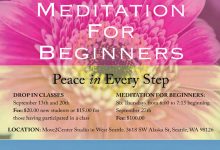
    Meditation for Beginners: Peace in Every Step

    Struggling with Anxiety, depression, or relationship issues? Are you tired of trying to fix yourself? Change is not something you force it is something you allow.  Learn how meditation allows change to occur naturally!

    Meditation can be a gentle first step toward connecting with your true self, healing old wounds and making choices that are truly right for you. In this class, Jeffrey Morrison, LHMC will introduce the practice of meditation as a sacred form of self care and path to personal fulfillment. Jeffrey’s somatic approach will guide you into a deeper, more compassionate relationship with yourself. You will learn to sense and appreciate your whole being and recognize your own needs.

    OFFERINGS:

    Drop in classes on September 13thand 20th
    Time: 6:00pm to 7:15pm
    Fee: $20.00 new students or $15.00 for those having participated in a class
    LOCATION: Move2Center Studio in West Seattle.
    3618 SW Alaska St, Seattle, WA 98126


    Meditation for Beginners: Peace in Every Step

    Six Thursdays from 6:00 to 7:15 beginning September 27th

    Fee: $100.00
    TIME: 6:00pm to 7:15pm
    LOCATION: Move2Center Studio in West Seattle.
    3618 SW Alaska St, Seattle, WA 98126

    For details and registration contact Jeffrey.